📞  — free, 24/7
 — free, 24/7| Package | Price per Dose | Price | |
|---|---|---|---|
| 90 tab | C$36.43 | C$4,684.35 C$3,279.04 Free shipping | |
| 60 tab | C$37.42 | C$3,207.29 C$2,245.11 Free shipping | |
| 30 tab | C$39.39 | C$1,688.04 C$1,181.63 Free shipping | |
| 20 tab | C$40.37 | C$1,153.48 C$807.44 Free shipping | |
| 10 tab | C$41.36 | C$590.79 C$413.56 Free shipping | |
| 90 tab | C$42.34 | C$5,443.98 C$3,810.78 Free shipping | |
| 60 tab | C$43.33 | C$3,713.71 C$2,599.60 Free shipping | |
| 30 tab | C$45.30 | C$1,941.25 C$1,358.87 Free shipping | |
| 20 tab | C$46.28 | C$1,322.29 C$925.60 Free shipping | |
| 10 tab | C$47.27 | C$675.20 C$472.64 Free shipping | |
| 90 tab | C$46.28 | C$5,950.40 C$4,165.28 Free shipping | |
| 60 tab | C$47.27 | C$4,051.33 C$2,835.93 Free shipping | |
| 30 tab | C$49.24 | C$2,110.05 C$1,477.04 Free shipping | |
| 20 tab | C$50.22 | C$1,434.83 C$1,004.38 Free shipping | |
| 10 tab | C$51.20 | C$731.47 C$512.03 Free shipping |
Disclaimer: This information is for adults in Canada and is not a substitute for professional medical advice. Consult a healthcare professional before starting, stopping, or changing any medicine.
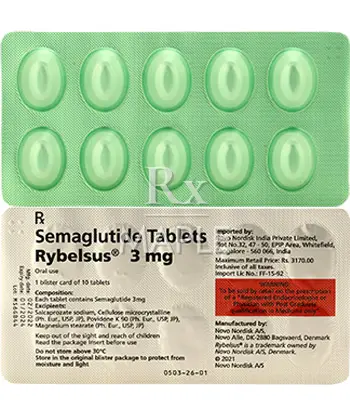
Rybelsus is an oral glucagon-like peptide-1 (GLP-1) receptor agonist used to improve glycemic control in adults with type 2 diabetes.
It contains the active ingredient semaglutide and is formulated as a tablet to be taken by mouth once daily.
As a GLP-1 receptor agonist, it mimics a natural gut hormone that enhances insulin secretion in response to meals and slows gastric emptying, contributing to lower blood glucose levels.
The primary therapeutic purpose is to lower fasting and postprandial (mealtime) glucose levels and to support weight management in suitable patients, when used as part of a comprehensive treatment plan that includes diet and exercise.
Rybelsus is indicated for adults with type 2 diabetes to help achieve better glycemic control when lifestyle measures alone are insufficient.
In practice, doctors may choose Rybelsus when a patient prefers an oral medication or when injections are not desirable, weighing this option against injectable GLP-1 receptor agonists or other antidiabetic agents.
Factors in decision-making include the patient’s ability to adhere to an oral routine, the potential for weight loss, cardiovascular considerations, kidney or liver function, and prior tolerance to GLP-1 therapies.
Consultation with a healthcare professional is essential to determine whether Rybelsus is appropriate, and to compare it with alternatives based on individual health needs and treatment goals.
Rybelsus acts on the GLP-1 receptor to promote glucose-dependent insulin secretion, suppress glucagon release after meals, and slow gastric emptying, which helps blunt post-meal glucose rises.
A principal difference from many GLP-1 products is the method of administration: Rybelsus is taken as an oral tablet, whereas several related medicines are delivered by subcutaneous injection on a daily or weekly schedule.
The pharmacodynamic profile includes appetite modulation and modest weight changes, as well as potential improvements in blood glucose control over several weeks with continued use.
Formulation and dosing schedule influence how the medicine is tolerated and how adherent a patient may be to the regimen, which can affect overall effectiveness compared with injectable options.
Rybelsus is compared here with select well-known GLP-1 receptor agonists to illustrate differences in use, onset, and practical advantages.
| Name | Primary use | Typical onset | Key advantage |
|---|---|---|---|
| Rybelsus | Glycemic control in adults with type 2 diabetes (oral tablet) | Glucose-lowering effects begin within weeks; full effect develops over time | Oral tablet formulation; convenient for individuals avoiding injections |
| Ozempic (semaglutide, injectable) | Glycemic control in adults with type 2 diabetes; may reduce cardiovascular risk in some patients | Onset within days to weeks after initiation | Weekly injection; strong cardiovascular data in select populations |
| Victoza (liraglutide) | Glycemic control in adults (and some younger patients) with type 2 diabetes | Effect seen within weeks to a couple of months | Daily dosing flexibility; cardiovascular outcome data available for some patients |
| Trulicity (dulaglutide) | Glycemic control in adults with type 2 diabetes | Effect develops over weeks with a weekly schedule | Weekly dosing; simple regimen for some patients |
When evaluating these options, considerations include delivery method (oral versus injection), dosing frequency, potential weight effects, and individual tolerance. For personalized recommendations, a healthcare professional should be consulted.
Note that cardiovascular outcomes and specific patient subgroups may influence the preferred choice; always review the official patient information and discuss with a pharmacist or prescriber for alignment with health goals.
Rybelsus is taken by mouth once daily, preferably at a time that fits the patient’s routine, at least 30 minutes before the first food, beverage, or other medications of the day.
Tablets should be swallowed whole with plain water; do not crush, chew, or split the tablet, as this can alter absorption.
If a dose is missed, continue with the next scheduled dose at the usual time. Do not double the next dose to make up for a missed one unless advised by a healthcare professional.
Medication storage requires keeping tablets in their original blister packaging and storing at room temperature away from moisture; avoid exposure to heat or moisture for extended periods.
Common adverse effects include nausea, vomiting, diarrhea, abdominal discomfort, and decreased appetite. These effects often lessen with continued use.
Serious adverse events may include pancreatitis and gallbladder disease; hypersensitivity reactions can occur in some individuals.
Rybelsus is not recommended in people with a personal or family history of medullary thyroid carcinoma or multiple endocrine neoplasia syndrome type 2. Pregnancy and lactation require medical counseling, as safety in these populations has not been established.
Concomitant use with other antidiabetic medications that carry hypoglycemia risk may increase the likelihood of low blood sugar, requiring monitoring and possible dose adjustments under professional supervision.
Rybelsus can affect the absorption of other oral medicines due to slowed gastric emptying; patients should discuss all current medications with a pharmacist and may need timing adjustments to avoid interactions.
Co-administration with other GLP-1 receptor agonists is generally not advised unless explicitly instructed by a healthcare professional.
Any new prescription, over‑the‑counter medication, or supplement should be disclosed to the prescribing clinician, as interactions can occur with various drug classes.
Severe dehydration, gastrointestinal illness with vomiting or diarrhea, or other acute conditions may necessitate temporary discontinuation or medical review of treatment with Rybelsus.
There is limited evidence for pediatric use; the medicine is not routinely recommended for children. Adult-specific guidance remains the standard unless otherwise directed by a clinician.
Older adults may experience different tolerability; monitoring for hydration status and gastrointestinal symptoms is advised during initiation and titration.
In kidney or liver impairment, adjustments may not always be necessary, but severe impairment or comorbidities require clinician assessment to determine suitability and safety.
For individuals planning pregnancy, currently available data are insufficient to establish safety; alternative diabetes management options should be discussed with a healthcare professional.
Rybelsus may require a prescription depending on local rules; confirm at the point of care with a clinician or pharmacist.
Short introductory notes are provided here; for personal medical decisions, rely on direct professional guidance and the official patient information leaflet.
Questions below address common concerns about switching, comparisons with alternatives, and practical use. If a question is not covered, seek professional advice for clarification.
Switching may be appropriate in some cases, but the change should be planned with a clinician. The transition may involve gradual changes to monitoring and adjustments to other diabetes therapies to minimize risks such as hypoglycemia or digestive symptoms.
Weight effects vary among individuals; both products can contribute to weight reduction in some patients, but the results depend on multiple factors and treatment context. A clinician can discuss expectations based on medical history and goals.
Some improvement is typically observed within weeks, with continued benefit over subsequent weeks as the therapy is maintained. Long-term glycemic control is best assessed over several weeks to months with regular monitoring.
Combination therapy is common in type 2 diabetes management; however, potential interactions and hypoglycemia risk require professional assessment. Dosing and monitoring plans should be tailored to the individual patient.
Generic versions may not be readily available in all regions; brand-name availability can change over time. Discuss options with a pharmacist or prescriber to understand current availability and costs.
If a dose is missed, resume the regular dosing schedule at the next planned time. Do not take extra medication to compensate for a missed dose unless advised by a clinician.
Rybelsus does not typically affect alertness or coordination in most people, but occasional dizziness or fatigue can occur. If such effects are experienced, motor activities should be approached with caution until tolerance is known.
Reasons may include a preference for an oral therapy, patient tolerability, potential weight considerations, and prior responses to GLP-1 therapies. Individual health status guides the final decision.
Consult the official patient information leaflet provided with the medication and speak with a pharmacist or prescriber for personalized guidance.
Health Canada resources and national diabetes guidelines can offer additional context for learning about treatment options, safety considerations, and monitoring requirements.
Reliable sources include documentation from regulatory authorities and the prescribing information supplied by the manufacturer; clinicians can help interpret these materials in the context of individual health needs.
14–21 days. Free from C$281.34 .
5–9 days. C$42.20
−10% when paying with cryptocurrency.
−10% on all repeat orders.
All orders are packed in neutral, unbranded boxes with no product name on the outside.