📞  — free, 24/7
— free, 24/7 — free, 24/7| Package | Price per Dose | Price | |
|---|---|---|---|
| 360 pills | C$1.40 | C$628.95 C$503.16 Free shipping | |
| 180 pills | C$1.50 | C$336.93 C$269.54 | |
| 120 pills | C$1.62 | C$242.08 C$193.66 | |
| 90 pills | C$1.76 | C$197.15 C$157.72 | |
| 60 pills | C$1.96 | C$147.24 C$117.79 | |
| 30 pills | C$2.40 | C$89.83 C$71.86 | |
| 360 pills | C$2.30 | C$1,033.29 C$826.63 Free shipping | |
| 180 pills | C$2.48 | C$556.57 C$445.26 Free shipping | |
| 120 pills | C$2.68 | C$401.82 C$321.46 Free shipping | |
| 90 pills | C$2.88 | C$324.45 C$259.56 | |
| 60 pills | C$3.15 | C$237.09 C$189.67 | |
| 30 pills | C$3.93 | C$147.24 C$117.79 | |
| 180 pills | C$3.51 | C$791.19 C$632.95 Free shipping | |
| 120 pills | C$3.77 | C$566.55 C$453.24 Free shipping | |
| 90 pills | C$4.11 | C$461.72 C$369.38 Free shipping | |
| 60 pills | C$4.59 | C$344.41 C$275.53 | |
| 30 pills | C$5.59 | C$209.63 C$167.71 | |
| 20 pills | C$5.79 | C$144.74 C$115.79 | |
| 10 pills | C$6.19 | C$77.35 C$61.88 |
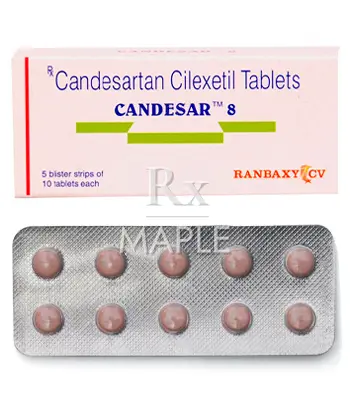
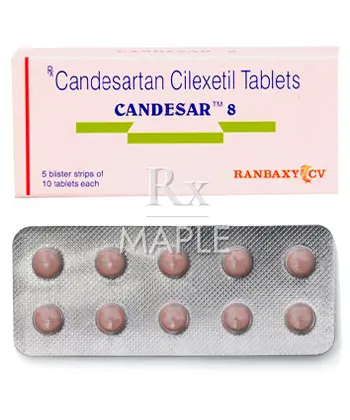
Candesartan is an angiotensin II receptor blocker (ARB) of the sartán class. It antagonizes the AT1 receptor, reducing angiotensin II–mediated vasoconstriction, aldosterone release, and sympathetic activation. It is primarily used to treat hypertension and to manage outcomes in heart failure with reduced ejection fraction.
Candesartan is administered as candesartan cilexetil, a prodrug that is rapidly hydrolyzed to the active candesartan. The active moiety binds AT1 receptors with high affinity, producing durable antihypertensive effects. Onset of blood pressure reduction occurs within hours, and maximal effects commonly emerge over several weeks as vascular remodeling proceeds. Oral bioavailability is modest; peak plasma concentrations are reached within about 3–4 hours in fasting states, and absorption can be modestly influenced by meals. Elimination occurs primarily through hepatic pathways with renal excretion contributing to clearance; dose adjustment may be required in renal impairment.
In essential hypertension, candesartan can be used as monotherapy or combined with a diuretic to reach clinic blood pressure targets. Dose may be titrated based on response and tolerability, with a typical range up to 32 mg once daily. The medication is generally well tolerated and may be preferred in patients where a RAAS blockade is desired without a persistent cough.
In heart failure with reduced ejection fraction, candesartan reduces cardiovascular mortality and hospitalization for heart failure when added to standard therapy (including beta-blockers and diuretics). It is also suitable for patients who cannot tolerate ACE inhibitors, offering an alternative route to RAAS blockade while providing demonstrable clinical benefit in symptom relief and outcome measures. Use in this setting requires careful titration with monitoring of blood pressure, renal function, and electrolytes.
Mechanism of action: Candesartan blocks the AT1 receptor for angiotensin II, preventing receptor-mediated vasoconstriction, aldosterone secretion, sodium retention, and sympathetic activation. The result is dilation of arteries and veins, reduced systemic vascular resistance, and lower preload and afterload in heart failure. Renal hemodynamics improve as intraglomerular pressure decreases, contributing to a favorable balance between filtration and perfusion.
Compared with ACE inhibitors, candesartan does not inhibit bradykinin breakdown, so cough is less common and angioedema risk is reduced, though not abolished. The net hemodynamic and neurohormonal effects underlie both antihypertensive efficacy and the morbidity and mortality benefits observed in heart failure trials when candesartan is used as part of guideline-directed therapy.
Most patients tolerate candesartan well. Common adverse effects include dizziness, fatigue, and lightheadedness, particularly after initiation or dose increases. Hyperkalemia risk is elevated in patients with renal impairment, diabetes, or concomitant potassium-sparing medications; periodic measurement of electrolytes is recommended. Serum creatinine may rise modestly after starting therapy or with dose escalation.
Angioedema is uncommon but potentially life-threatening; risk is lower than with ACE inhibitors but warrants prompt evaluation and discontinuation if suspected. Absolute contraindications include pregnancy and bilateral renal artery stenosis; caution is advised in unilateral stenosis or significant renal impairment. Drug interactions of clinical importance include NSAIDs, potassium supplements, and other RAAS inhibitors; monitor renal function and electrolytes when these agents are used together. Initiation or adjustment should occur under medical supervision with appropriate follow-up.
Pregnancy is a contraindication; candesartan can cause fetal injury or death. There is limited information on use during lactation; a decision should be made to discontinue or avoid breastfeeding while using candesartan. Regular monitoring should include renal function and electrolytes; counsel patients to report dizziness or signs of hyperkalemia. Avoid NSAIDs when possible and review all concomitant medications that affect potassium or renal function.
14–21 days. Free from C$285.25 .
5–9 days. C$42.79
−10% when paying with cryptocurrency.
−10% on all repeat orders.
All orders are packed in neutral, unbranded boxes with no product name on the outside.