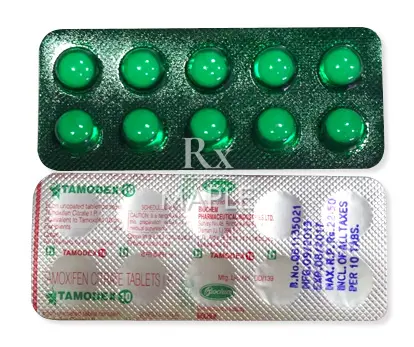
📞  — free, 24/7
— free, 24/7 — free, 24/7| Package | Price per Dose | Price | |
|---|---|---|---|
| 360 pills | C$0.76 | C$390.76 C$273.53 | |
| 270 pills | C$0.88 | C$339.42 C$237.59 | |
| 180 pills | C$0.94 | C$242.43 C$169.70 | |
| 120 pills | C$1.10 | C$188.24 C$131.77 | |
| 90 pills | C$1.28 | C$165.42 C$115.79 | |
| 60 pills | C$1.46 | C$125.48 C$87.84 | |
| 30 pills | C$2.60 | C$111.22 C$77.85 | |
| 20 pills | C$3.59 | C$102.66 C$71.86 | |
| 360 pills | C$1.20 | C$616.11 C$431.28 Free shipping | |
| 270 pills | C$1.30 | C$502.01 C$351.41 Free shipping | |
| 180 pills | C$1.44 | C$370.80 C$259.56 | |
| 120 pills | C$1.56 | C$268.11 C$187.67 | |
| 90 pills | C$1.68 | C$216.76 C$151.73 | |
| 60 pills | C$1.84 | C$156.86 C$109.80 | |
| 30 pills | C$1.94 | C$82.69 C$57.89 | |
| 20 pills | C$2.30 | C$65.58 C$45.91 |
Discovered in the 1960s by Imperial Chemical Industries as a nonsteroidal antiestrogen, tamoxifen is a cornerstone selective estrogen receptor modulator (SERM) widely used in estrogen receptor–positive breast cancer. Its pharmacologic profile combines receptor antagonism in breast tissue with partial agonist activity in bone and, to a lesser extent, the endometrium, yielding a distinctive therapeutic balance. Active metabolites, notably endoxifen and 4-hydroxytamoxifen, contribute substantially to clinical efficacy after hepatic biotransformation.
Tamoxifen acts by modulating estrogen receptor signaling in a tissue-selective manner. In malignant breast tissue, estrogen receptor blockade reduces cellular proliferation driven by estrogen. In bone, estrogenic signaling helps preserve mineral density, whereas uterine exposure to partial agonism accounts for some safety concerns. Pharmacokinetically, the parent compound undergoes extensive hepatic metabolism with formation of active metabolites that sustain receptor engagement even as parent drug levels wane.
Therapeutic dosing is typically 20 mg orally once daily, with regimens tailored to indication, menopausal status, and tolerability. Adjuvant therapy for ER-positive disease commonly spans five years, though clinical practice may extend or abbreviate duration based on risk assessment and adverse effects. Clinicians monitor hepatic function, drug interactions (notably CYP2D6–mediated pathways), and signs of endometrial or thromboembolic events during therapy.
Tamoxifen is among several SERMs that share a core mechanism—estrogen receptor modulation—but differ in tissue selectivity and safety profiles. Raloxifene, for instance, exhibits minimal estrogenic stimulation of the endometrium and is used primarily for osteoporosis risk reduction and, in select settings, breast cancer risk management rather than for treatment of established ER-positive breast cancer.
Toremifene resembles tamoxifen in its antagonism of breast estrogen receptors but has distinct pharmacokinetic properties and receptor affinity. Differences in endometrial effects, lipid modulation, and adverse-event patterns can influence clinical choice. Other SERMs, such as ospemifene, display tissue-specific activity for non-oncologic indications but are not standard therapies for malignant disease, illustrating the heterogeneity within this drug class.
Genetic and pharmacologic factors affecting tamoxifen action—especially CYP2D6–mediated formation of endoxifen—may alter therapeutic outcomes. When selecting a SERM, clinicians weigh efficacy in breast cancer against risks of endometrial stimulation and venous thromboembolism, while considering patient comorbidity and concomitant medications.
Tamoxifen is approved as adjuvant therapy for ER-positive breast cancer in both premenopausal and postmenopausal patients, with the aim of reducing recurrence and improving survival when used as part of multi-modal treatment. It is also indicated for the treatment of metastatic ER-positive breast cancer and for selected indications in ductal carcinoma in situ to reduce the risk of disease progression.
In addition to treatment, tamoxifen serves a chemopreventive role in women at high risk for breast cancer, where the balance of absolute risk reduction versus adverse effects is considered in shared decision making. It is also used in male breast cancer settings where ER expression guides systemic therapy. Dosing commonly remains at 20 mg daily, with durations ranging from several years based on risk stratification and tolerability.
Contraindications include pregnancy and lactation, given potential teratogenic effects. Hepatic impairment necessitates cautious use and possible dose modification. Clinicians assess potential drug interactions—especially with CYP2D6 inhibitors—and monitor for gynecologic changes, thromboembolic risk, and other adverse effects throughout therapy.
Tamoxifen, raloxifene, and toremifene represent a subset of SERMs with overlapping yet distinct profiles. The following summary highlights core distinctions that influence therapeutic decision making and risk management.
The table that follows compares representative agents across indications, pharmacology, and safety considerations to assist in clinical interpretation and patient counseling.
| Agent | Primary Indications | Mechanism/Notes | Notable Safety Considerations |
|---|---|---|---|
| Tamoxifen | ER-positive breast cancer (treatment and adjuvant), DCIS risk reduction, chemoprevention in high-risk women | SERM with estrogen receptor antagonism in breast; partial agonism in bone/uterus; active metabolites (endoxifen, 4-hydroxytamoxifen) potentiate effect | Increased risk of venous thromboembolism and endometrial pathology; interactions with CYP2D6 inhibitors can lower active metabolite levels |
| Raloxifene | Postmenopausal osteoporosis risk reduction; breast cancer risk reduction in select populations | SERM with minimal endometrial stimulation; does not treat established ER-positive breast cancer | VTE risk; hot flashes; no requirement for endometrial cancer surveillance as with tamoxifen |
| Toremifene | ER-positive metastatic breast cancer in various jurisdictions | SERM with receptor antagonism similar to tamoxifen but distinct pharmacokinetics; different receptor affinity | QT prolongation risk and other cardiac considerations; endometrial effects less well defined than with tamoxifen |
Overall, selection among SERMs hinges on disease state, endometrial safety considerations, thromboembolic risk, and potential drug interactions with metabolic pathways such as CYP2D6. The table underscores that while these agents share a common mechanism, clinical use diverges according to tissue effects and patient comorbidity.
Most patients experience vasomotor symptoms (hot flashes), fatigue, and vaginal discharge or spotting, which are typically mild to moderate and dose-related. Menopausal symptoms may impact quality of life and adherence, particularly during the early months of therapy. Weight changes and edema can occur but are generally not dose-limiting in the majority of patients.
Two principal safety concerns require ongoing vigilance: venous thromboembolism and endometrial pathology. Tamoxifen increases the risk of DVT/PE and, due to endometrial estrogenic activity, modestly raises the incidence of endometrial hyperplasia or carcinoma with prolonged use. The risk-benefit balance should be re-evaluated in older patients and those with a prior thromboembolic event or uterine pathology.
Drug interactions are clinically important. CYP2D6 inhibitors (for example, certain antidepressants such as paroxetine or fluoxetine) can reduce formation of the active metabolite endoxifen, potentially diminishing efficacy. Clinicians should review concomitant medications and consider alternative agents when initiating tamoxifen. Hepatic impairment demands careful monitoring and may influence dose selection or duration of therapy. Pregnancy and breastfeeding are contraindicated due to fetal risk; contraception is advised during treatment.
14–21 days. Free from C$285.25 .
5–9 days. C$42.79
−10% when paying with cryptocurrency.
−10% on all repeat orders.
All orders are packed in neutral, unbranded boxes with no product name on the outside.